

Mountain Grown Coffee: Why Elevation Matters, But Doesn’t Tell the Whole Story
For many people (around our age, anyway), the phrase “mountain grown coffee” came to mean “better coffee.”
From a marketing standpoint, it was brilliant. Two words gave coffee drinkers an image they could understand immediately: clean air, high slopes, cooler temperatures, slower growth, better beans.
And there is truth in it.
Elevation does matter. It can influence how slowly the coffee cherry matures, how dense the seed becomes, and how much structure, sweetness, or brightness the coffee may carry into the cup.
But elevation does not do that work alone.
A coffee does not become excellent simply because it was grown on a mountain. Elevation works differently depending on the country, region, soil, plant variety, rainfall, shade, processing method, drying conditions, producer skill, and roast development.
We pay attention to elevation, of course. We just don’t treat it like a magic number. It is one clue in a much larger coffee story.
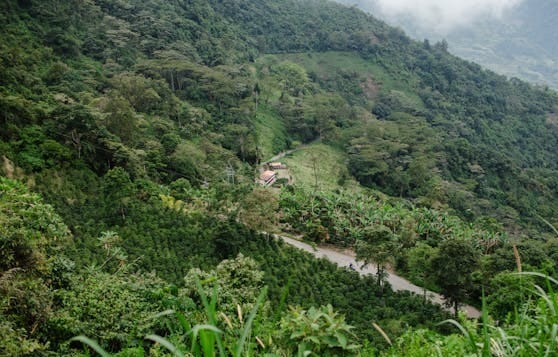
Terroir
Before we go too far into elevation, we need to talk about a word that gets used a lot in both coffee and wine circles: terroir.
Terroir simply means, “the growing environment of an agricultural product.”
In coffee, that includes elevation, climate, soil, rainfall, shade, sun exposure, temperature, plant variety, and farming choices. Terroir is not one of those things by itself. It is the relationship between all of them.
That is why “mountain grown” matters, but not in the simplistic way people often think.
Elevation is part of terroir. It is not terroir by itself.
A coffee grown at 5,000 feet in Kenya is not automatically going to taste like a coffee grown at 5,000 feet in Papua New Guinea, Haiti, or Brazil. The elevation gives us a clue, but the place gives us the story.
In other words, elevation matters because place matters.
So, What Does Elevation Actually Do?
When people talk about high-altitude coffee, elevation can start to sound like a scorecard. The higher the elevation, the better the coffee. Lower elevation sounds less impressive.
Coffee does not work that way.
A coffee grown at 5,000 feet in one country is not automatically experiencing the same conditions as a coffee grown at 5,000 feet somewhere else. That is because elevation interacts with latitude.
In plain English, where the farm sits on the globe changes what that elevation actually means.
Elevation and latitude both influence temperature, and together they help shape the climate around the coffee plant. That matters because coffee development is deeply tied to temperature.
Cooler growing conditions can slow the maturation of the coffee cherry. Slower maturation can give the seed more time to develop density, sugars, acids, and the compounds that later become aroma and flavor during roasting.
So, when we say elevation matters, what we really mean is that the growing temperature matters, and elevation is one of the forces that shapes it.
That is why “mountain grown” was clever marketing, but incomplete coffee education.
The mountain matters.
Where the mountain is matters more.
What Our Own Coffee History Shows Us
Over the years, we have tracked the coffees we bring in by origin, region, elevation, processing method, varietal, body, acidity, flavor notes, roast profile, cup score, and pairing behavior.
That database has become more than a list of coffees we have roasted. It has become a record of how different growing conditions show up in the cup.
One of the clearest patterns is this: coffees grown in similar elevation bands do not automatically taste alike.
Some are clean and sweet. Some are chocolatey and low-acid. Some are bright and fruit-forward. Some are round, nutty, or caramel-sweet. Some are earthy and syrupy. Some are delicate and tea-like. Some have enough body to stand up to chocolate, barbecue, or rich breakfast foods. Others shine better with fruit desserts, lighter pastries, or creamy cheeses.
Same general altitude. Very different cup.
That is the point.
Elevation can influence density, sweetness, acidity, and complexity, but the final cup also depends on latitude, soil, rainfall, shade, variety, processing, drying, storage, and roast development.
Processing especially changes the expression of a coffee. Washed, natural, honey, semi-washed, and wet-hulled coffees do not behave the same way, even when the elevation looks similar. Processing is one of the ways the producer translates the grown coffee into a finished green coffee.
That is also why body and acidity usually tell us more about the drinking experience than elevation alone.
Customers do not drink elevation.
They experience brightness, sweetness, smoothness, body, aroma, finish, and balance.
So yes, elevation matters. But not because “mountain grown” is a magic spell.
It matters because it helps shape the growing environment, especially temperature, and temperature influences how slowly the coffee cherry matures and how the seed develops.
But the full story of a coffee is always found in the relationship between place, process, people, roast, and the final cup.
That is why we look at elevation as a clue, not a conclusion.